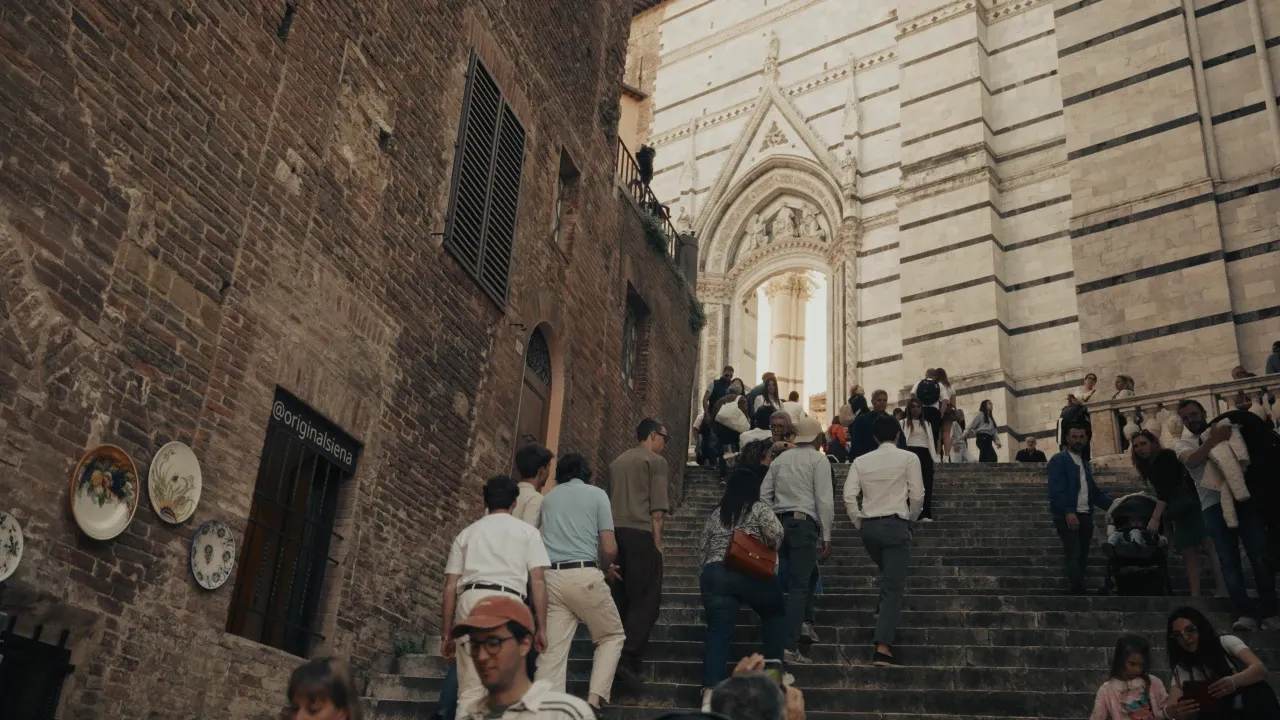
Here are the Siena contrade explained in one sentence: the historic center of Siena is divided into 17 wards, called contrade, each with its own name, emblem, colors, church, museum and fountain. They are best known as the teams of the Palio horse race, but for the Sienese they are first of all a neighborhood, a community and an identity that begins at birth.
Walk through the city and you see them everywhere once you know what to look for: small ceramic plaques marking boundaries, flags hanging from windows, animal emblems on fountains and street corners. This guide explains what a contrada is, where the system came from and how visitors can see it outside the days of the race.
Siena contrade explained: what is a contrada?
A contrada is a district of the old city with fixed borders, its own government and its own traditions. Each one has an oratory or church, a headquarters, a museum that holds its banners and trophies, and a social club where members eat, meet and organize events through the year. Membership is usually by birth: being born within a contrada’s borders, or into a family that belongs to it, makes you part of it.
The contrade are grouped into three larger sections of the city, called terzi: the Terzo di Città, the Terzo di San Martino and the Terzo di Camollia. The terzi follow the three ridges on which Siena is built, and they still shape how the Sienese describe their city.
Members baptize newborns into the contrada, often at its own small fountain during the yearly feast of the contrada’s patron saint. This is a civic ceremony rather than a religious one, and it marks a bond that most Sienese keep for life, whatever their address later.
Where the 17 contrade came from
The contrade grew out of the neighborhoods of the medieval city, which organized militias, festivals and local life. Over time there were more of them than today, and disputes over borders were common.
In 1729 Violante of Bavaria, the Medici governor of Siena, issued a decree that fixed the number at 17 and defined their borders. Those boundaries are essentially the ones still in force. Some older contrade were absorbed or disappeared, and the system has remained closed ever since: no new contrada has been added.
The 17 contrade
Aquila (eagle), Bruco (caterpillar), Chiocciola (snail), Civetta (owl), Drago (dragon), Giraffa (giraffe), Istrice (porcupine), Leocorno (unicorn), Lupa (she-wolf), Nicchio (seashell), Oca (goose), Onda (wave, with a dolphin emblem), Pantera (panther), Selva (forest, with a rhinoceros emblem), Tartuca (tortoise), Torre (tower, carried by an elephant) and Valdimontone (ram).
Symbols, colors and fountains
Each contrada has an animal or emblem, a combination of colors and a motto. The colors appear on flags, scarves and the costumes worn in historical parades, and you quickly learn to recognize them as you walk. Look for the street plaques that mark where one contrada ends and another begins.
Many contrade have a small fountain, known as a fontanina, decorated with their emblem. They are among the most charming details of the city: the Aquila, the Torre, the Leocorno and the Civetta all have one, and finding them makes a good thread for a walk through less visited streets.
Some contrade have historic friendships with others, and some have a traditional rival. These relationships are serious matters in Siena and show up most clearly around the Palio, but they also color everyday conversation in the city.
Contrade beyond the Palio
The Palio is run twice a year in Piazza del Campo, on 2 July and 16 August. Only ten contrade take part in each race: the seven that did not run in the same race the previous year, and three drawn by lot. The race lasts barely more than a minute, but the preparation and the life of the contrade fill the whole year.
Outside race days, the contrade hold dinners, concerts and festivals, run youth activities and care for elderly members. The yearly feast of each contrada brings drummers and flag-wavers through the streets, as members visit allied contrade and the city’s institutions. If you are in Siena when one of these feasts is under way, you will hear it before you see it.
For a visitor, the most accessible door into this world is a contrada museum. The Chiocciola, for example, keeps its collection in rooms connected to its church, and the Onda has a modern museum devoted to its history and traditions. Opening is often by appointment or on specific days, so check with the tourist office or the contrada itself before you go.
A few points of etiquette help. Contrada scarves and flags are worn with real feeling, so do not treat them as souvenirs to wave around at random, and do not take sides in a rivalry you do not understand. If you come across a contrada dinner or procession, watch from the side and let it pass; you are a guest in someone’s neighborhood, and people notice when visitors are respectful.
Seeing Siena through its contrade
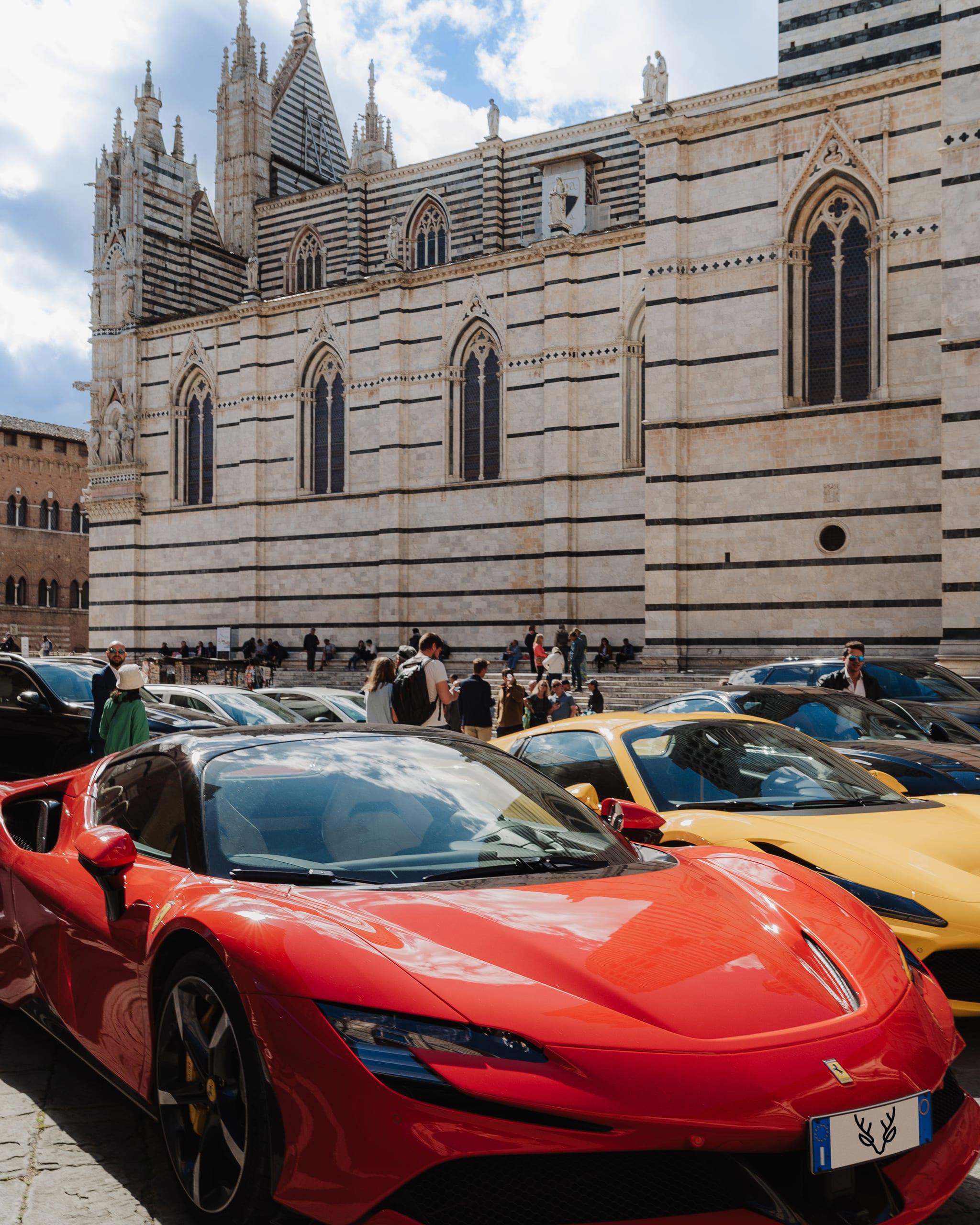
Understanding the contrade changes the way you see Siena. Streets that looked the same start to belong to someone, and details like plaques, flags and fountains begin to tell a story. Give yourself a slow morning in the city, then leave the walls behind: Rocca d’Italia’s Medieval Tuscany day starts in Siena and takes you in a classic car through Monteriggioni and the Val d’Elsa to San Gimignano, another town shaped by its medieval past.
Questions about the Siena contrade
How many contrade are there in Siena?
There are 17 contrade. Their number and borders were fixed by a decree of 1729 under Violante of Bavaria, and they have not changed since.
Do all 17 contrade run in the Palio?
No. Ten contrade run in each Palio: the seven that missed the same race the previous year and three drawn by lot.
Can tourists visit a contrada museum?
Yes. Several contrade open their museums to visitors, often by appointment or on set days. Ask at the tourist office or contact the contrada directly.
How do you become a member of a contrada?
Usually by birth, either within the contrada’s borders or into a family that belongs to it. Newborns are welcomed with a civic baptism, often at the contrada’s fountain.
What does contrada mean in Siena?
A contrada is one of the 17 historic wards of Siena. Each has fixed borders, its own emblem and colors, a church, a museum and a social club, and it runs its own life all year, not only for the Palio.
What are the three terzi of Siena?
The Terzo di Città, the Terzo di San Martino and the Terzo di Camollia. They are the three historic sections of the city, and each groups several contrade.