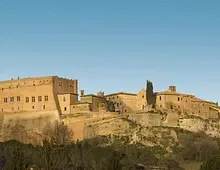
Radicofani, Italy, is a small stone village at the southern end of the Val d’Orcia, crowned by a fortress that sits on a basalt outcrop at about 896 meters, high above the southern end of the valley. From the top you look across to Monte Amiata and over the border into Lazio, and on a clear day the Val d’Orcia spreads out below like a map.
Most travelers see the fortress only as a silhouette from the road between Pienza and the south. It is worth stopping. Radicofani has a medieval outlaw, a long history as a border post and a place on the Via Francigena, and it adds a quieter, wilder half day to a trip based around San Quirico d’Orcia or Pienza.
The Rocca of Radicofani, Italy
The fortress, known locally as the Rocca, is mentioned in documents as early as 978. Its position explains why it mattered for so long: it watches over the old road between Tuscany and Lazio, and for centuries whoever held it controlled one of the main routes between Siena and Rome.
Siena held and defended it during the age of the republic. After the Sienese state fell to Florence in the sixteenth century, Cosimo I de’ Medici had the medieval castle modernized into a fortress with bastions, adapted to the age of artillery. For a long time afterward the Rocca guarded the frontier between the Grand Duchy of Tuscany and the Papal States.
Today the fortress has been restored and is open to visitors. Inside, a small museum displays archaeological finds from the area, from ancient times to the sixteenth century, and the main draw is the walk up to the keep and the views from the walls. Check the official tourism pages for opening times, which change with the season.
From the top of the keep the geography of southern Tuscany makes sense. To the west rises Monte Amiata, the old volcano whose wooded slopes close the horizon; to the north the Val d’Orcia opens toward Pienza and San Quirico; to the south and east the land falls away toward Lazio and Umbria. It is the best place in the valley to understand why this hill was fought over for so long.
Ghino di Tacco, the Robin Hood of Tuscany
The name you will hear everywhere in Radicofani is Ghino di Tacco. A member of a noble family from the Sienese countryside, he was outlawed by Siena and turned brigand, and in the late thirteenth century he made the fortress of Radicofani his base. From the hilltop he controlled traffic along the road below.
Legend made him a gentleman bandit who robbed the rich, treated his prisoners with courtesy and helped the poor. He appears in Dante’s Divine Comedy and in Boccaccio’s Decameron, where he holds the wealthy abbot of Cluny captive and cures his stomach complaint with a strict diet before letting him go. That story did more than anything else to fix his reputation as the Robin Hood of Italy.
The village has embraced him, and you will find his name on shops and restaurants. As with most legends, separate the man from the myth, but the setting makes it easy to imagine him watching the road from the walls.
Radicofani on the Via Francigena
The Via Francigena, the medieval pilgrim route from Canterbury to Rome, runs straight through Radicofani. The stage from San Quirico d’Orcia to Radicofani is one of the toughest in Tuscany, with a long climb at the end, and the next stage leads on to Acquapendente, the last stretch in Tuscany before the route enters Lazio.
You will see walkers with backpacks and pilgrim passports in the village, especially in spring and autumn. Even if you are traveling by car, the history of the route explains the shape of the place: a hill town built along the road, with inns and churches serving the travelers who passed through on their way to Rome.
Getting there and what to pair it with
Radicofani lies just off the old Via Cassia, south of San Quirico d’Orcia. From San Quirico or Pienza the drive takes well under an hour through open country, and from Siena allow roughly an hour and a half. The last stretch climbs steadily, and the fortress stays in view for most of the way.
Leave the car in the parking areas below the old center and walk up; the streets are steep and narrow. The village is small and can be seen in an hour, with the fortress taking another hour or so.
The natural companions are to the west and north. Bagni San Filippo, with its white limestone thermal formations, is a short drive toward Monte Amiata. Bagno Vignoni and San Quirico d’Orcia lie back up the valley. A loop that starts in Pienza, drops south to Radicofani and returns by Bagni San Filippo and Bagno Vignoni makes a full, unhurried day.
When to go
Spring and autumn give the clearest views and the most comfortable walking. In winter the fortress can be windy and cold at this altitude, and in summer the midday light flattens the view, so aim for the morning or late afternoon.
Before you go
Radicofani rewards travelers who already know the Val d’Orcia and want to see its edge rather than its postcard center. Check opening times for the fortress before setting out, and bring a layer even in warm months. If you want to explore the valley’s roads from the driver’s seat or with a chauffeur before heading south, Rocca d’Italia runs private days across the Val d’Orcia from Siena, and you can extend the plan from there.
Questions about Radicofani
Is Radicofani worth visiting?
Yes, if you are already in the Val d’Orcia and enjoy history and views. The fortress offers the widest panorama in the valley, and the village is quiet compared with Pienza or Montalcino.
Who was Ghino di Tacco?
A thirteenth-century nobleman turned brigand who made the fortress of Radicofani his base in the late 1200s. Dante and Boccaccio wrote about him, and legend remembers him as a gentleman outlaw, a Tuscan Robin Hood.
How high is the fortress of Radicofani?
It stands on a basalt outcrop at about 896 meters above the southern Val d’Orcia, with views to Monte Amiata and into Lazio.
Is Radicofani on the Via Francigena?
Yes. The pilgrim route arrives from San Quirico d’Orcia and continues to Acquapendente, its last stage in Tuscany before Lazio.
Where is Radicofani?
Radicofani is in the province of Siena, at the southern end of the Val d’Orcia, close to the border with Lazio. It lies just off the old Via Cassia, south of San Quirico d’Orcia.
How long do you need in Radicofani?
Two hours is enough for the village and the fortress. Combine it with Bagni San Filippo or Bagno Vignoni for a half day or a full day in the southern Val d’Orcia.